
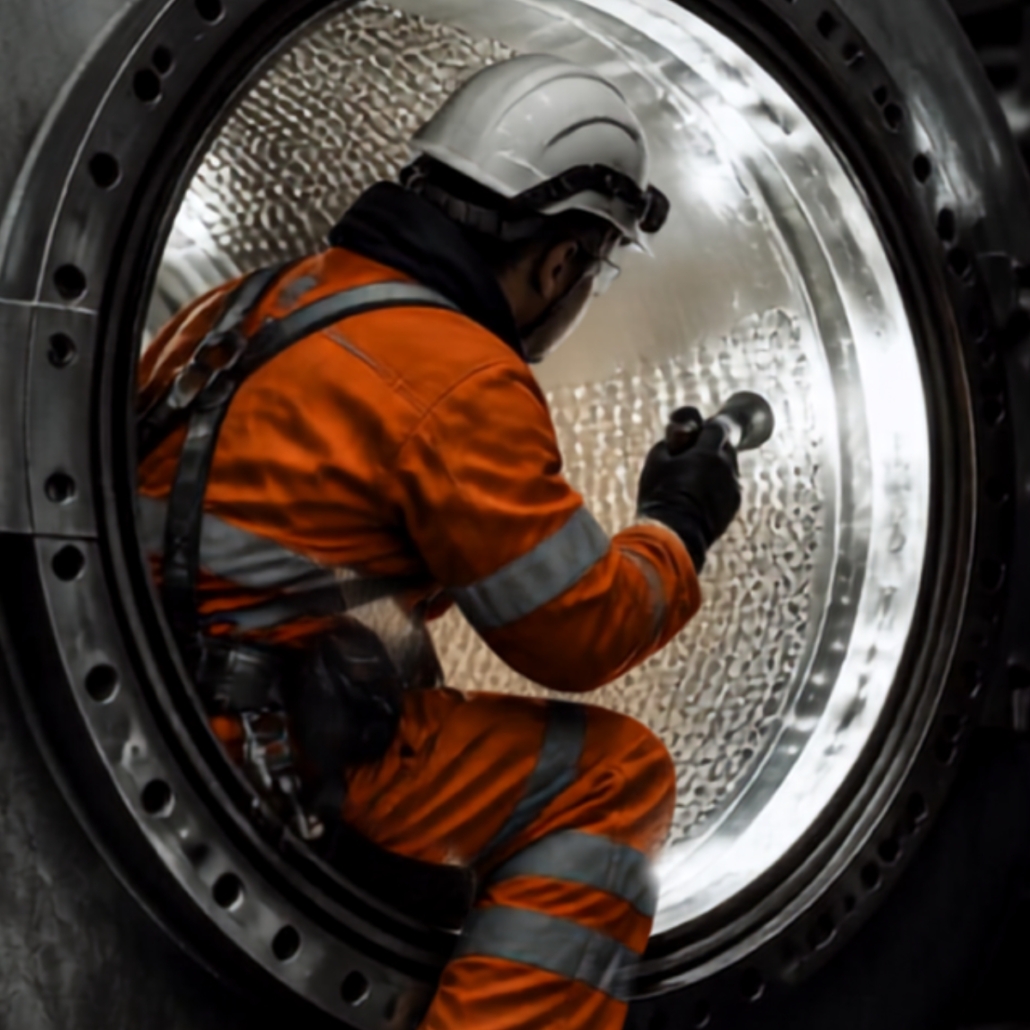
Vessels, Exchangers & Drums: The Mechanical Work That Defines a Turnaround
In a refinery or petrochemical turnaround, the mechanical scope on pressure vessels, heat exchangers, and process drums represents some of the most technically demanding and schedule-critical work of the entire outage. These are the components inaccessible during normal operations, whose condition is often unknown until the unit opens, and whose repair timeline directly determines when the facility returns to production.
Why Vessel and Exchanger Work Drives Turnaround Timelines
Pressure vessels in refinery and chemical service operate under continuous thermal cycling, internal pressure, and corrosive process exposure. By the time a turnaround opens a vessel for inspection, accumulated damage — erosion-corrosion on internal surfaces, weld seam degradation, nozzle cracking, head plate thinning — often exceeds what pre-outage engineering projected. Turnaround mechanical crews must execute not just the planned scope, but the reactive scope that emerges from inspection findings. The ability to absorb that scope growth — within hours, not days — is what keeps the turnaround from running over schedule when the unexpected appears.
The Full Scope of Vessel and Exchanger Mechanical Services
- Vessels and Drums: Internal weld overlay, nozzle replacement, shell repair, man-way maintenance, inspection support
- Heat Exchangers: Bundle extraction and replacement, tube-to-tubesheet re-rolling, channel and shell repair, gasket replacement
- Tower Field Services: Tray removal and reinstallation, packing replacement, downcomer welding, column inspection support
- Heaters and Furnaces: Tube replacement and welding in radiant and convection sections, refractory support, skin thermocouple installation
- Boilers and Reformers: Tube welding, manifold repair, casing weld repairs, specialty alloy work in high-temperature service
Capability Under Extreme Conditions
WISE turnaround specialists are qualified to perform welding and mechanical operations at elevated temperatures from 150°F to 380°F — a capability that allows repairs to be completed without requiring full unit cooldown in certain applications. This reduces turnaround duration and keeps the critical path moving where other crews would require extended cool-down windows.
Scope Growth Readiness
The most operationally valuable attribute of a turnaround mechanical crew is not their ability to execute the planned scope — it is their ability to absorb scope growth without losing pace. A crew backed by a staffing partner with additional qualified personnel available is the only reliable response to inspection findings that always change the plan.

