
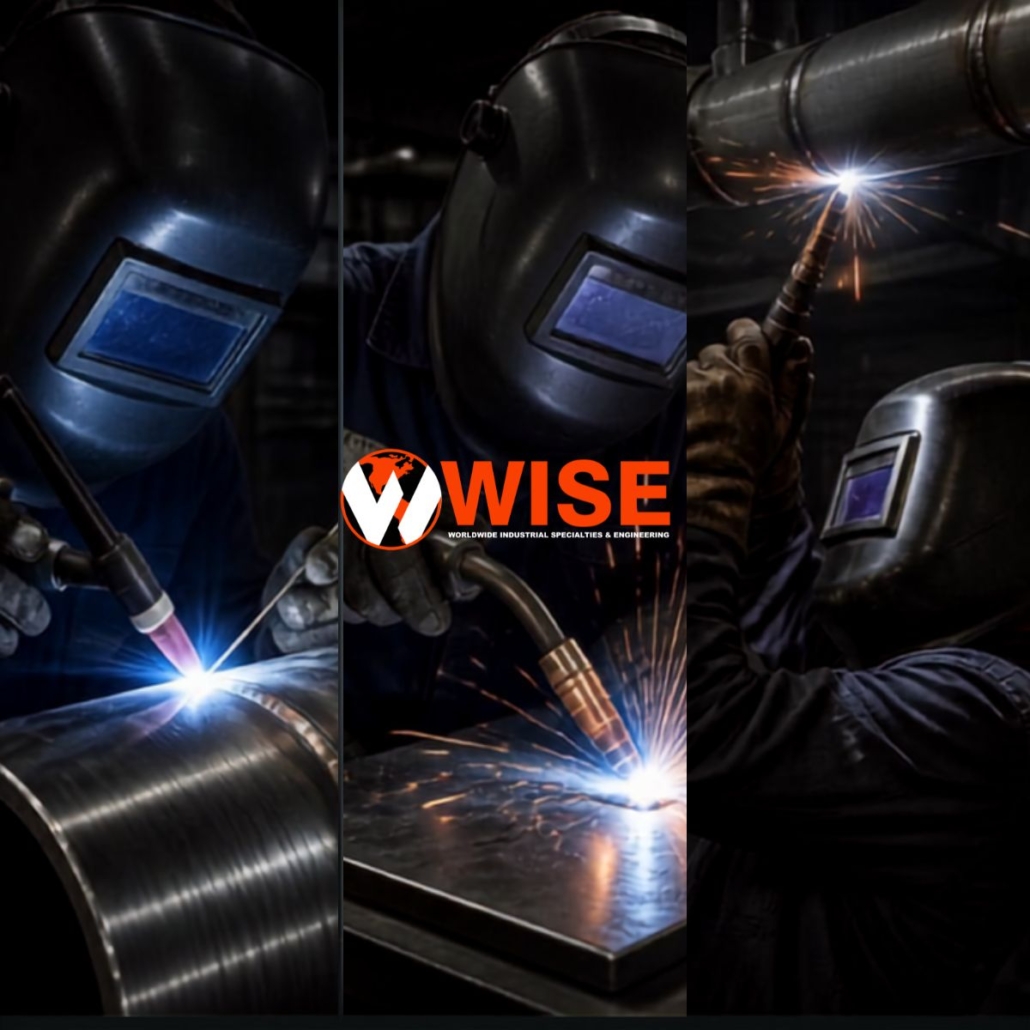
TIG, MIG, and 6GR Welding: Understanding Their Roles in Industrial Work
TIG, MIG, and 6GR Welding: Understanding Their Roles in Industrial Work
Industrial welding is often described by process names, but selecting a process involves much more than choosing between TIG, MIG, or a qualification such as 6GR. The correct approach depends on the material, joint geometry, access, production environment, required deposition rate, and the quality criteria of the component.
TIG Welding: Control for Demanding Joints
Gas tungsten arc welding, commonly called TIG, gives the welder precise control over the arc and filler metal. It is frequently associated with pipe roots, stainless steels, nickel alloys, thin-wall components, and applications where cleanliness and control are more important than speed.
TIG is especially valuable when the weld pool must remain small and stable. However, its lower deposition rate means preparation, fit-up, shielding, and welder technique must be carefully managed to keep productivity consistent.
MIG Welding: Productivity and Repeatability
Gas metal arc welding, commonly called MIG, continuously feeds wire through the gun. In suitable conditions, it can produce higher deposition rates and reduce arc-start interruptions. It is often useful for fabrication, structural components, and repetitive welds where access and shielding conditions are controlled.
MIG performance depends strongly on wire selection, transfer mode, voltage, travel speed, gun angle, and shielding gas. Outdoor wind, surface contamination, and poor parameter control can quickly reduce weld quality.
What 6GR Actually Describes
6GR is a restricted pipe-welding test position, not a separate welding process. The pipe is fixed at an angle and a restriction ring limits access, creating a demanding qualification that evaluates the welder’s ability to work around the joint under constrained conditions.
A 6GR qualification is commonly relevant to tubular connections and difficult-access work, but it does not automatically qualify every process, material, thickness, or production application. The applicable procedure and qualification range still govern the work.
The Practical Selection Factors
- Base material and filler-metal compatibility
- Joint type, wall thickness, and access
- Required production rate and heat-input limits
- Indoor, outdoor, or confined working conditions
- Inspection criteria and applicable welding procedure

